

Forum Replies Created
-
AuthorPosts
-
::
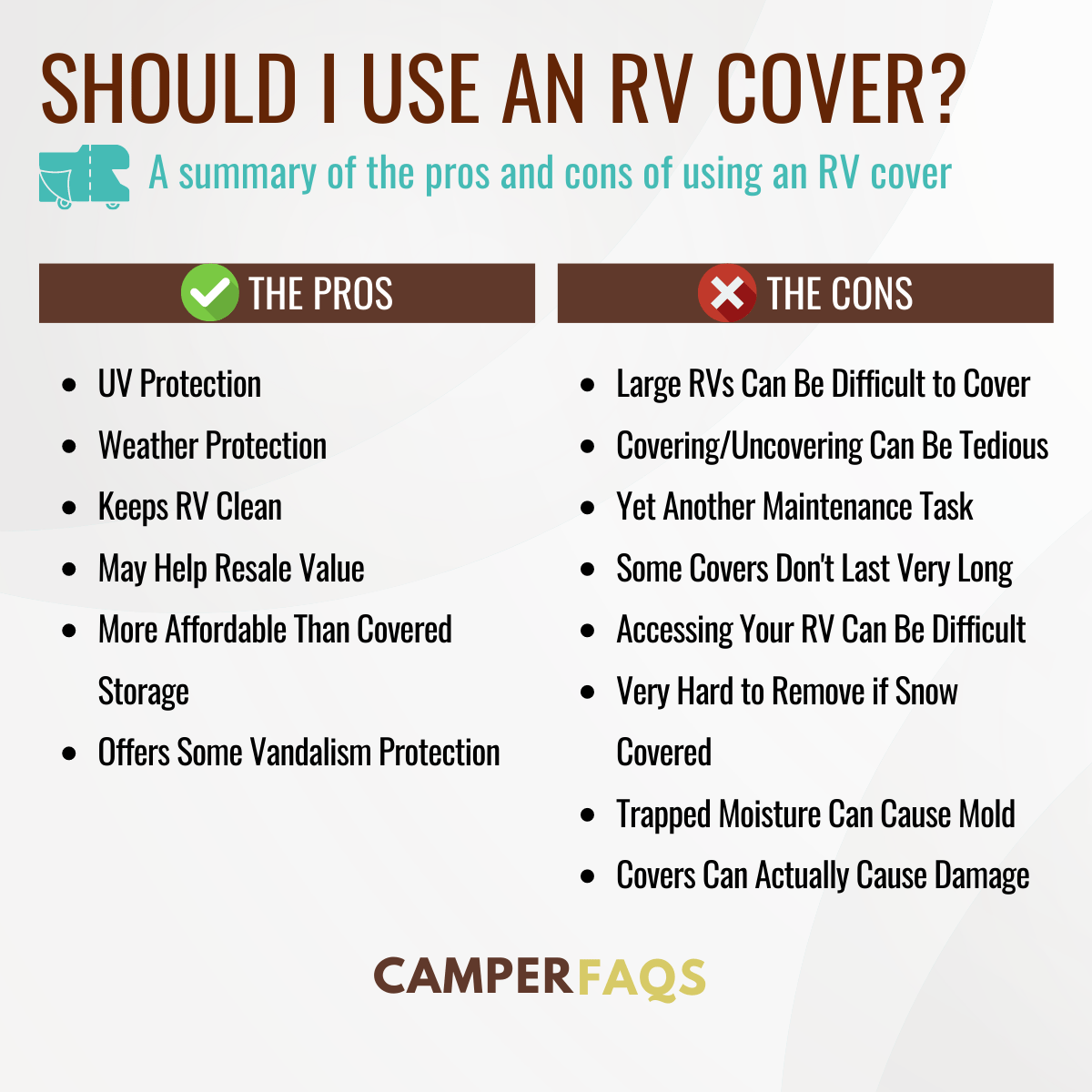
There are pros and cons to covering an RV in summer. I’ve touched on it in this article here: https://camperfaqs.com/should-i-cover-my-rv-in-the-summer
Here’s a quick pros and cons graphic.
I’ve never covered mine in summer, but it is in the shade most of the day, I keep it clean and waxed, and I use 303 UV protectant where it makes sense.
::Good question! Silicone lubricant should work. If it doesn’t, try the method in this video.
::Exactly what @IA_Camper said. You’ll need to get on your roof, remove the AC cover and check the drain pan. If you’re not comfortable doing that, then have a service tech do it. It wouldn’t hurt to service and clean your AC every year to prevent things like this.
::When I’m trip planning at home I just use Google maps to get a good idea of the route. On the road, I use a Garmin 795. An RV GPS, and especially Google Maps, are not perfect. But an RV GPS is invaluable when it comes to RV-specific features like avoiding low clearances, steep grades, and more.
I also carry a Rand McNally Motor Carriers Road Atlas, but I hope i never have to break it out…lol
::Keep’em coming! 🙂 I wouldn’t say there is a specific MPH of wind to look out for, as each motorized or towable camper will be different, the comfort levels and experience of the driver will be different, the unpredictability of winds, and so on.
That said, there are specific measures you can take if you find yourself caught in strong winds, like slowing down to give yourself more control, steady steering (proper countersteering and preventing oversteering), and knowing when to pull over and wait for the winds to die down.
Hope that helps.
::@ia_camper is correct. You’ll hear just as many people say they work as they don’t work. And there’s no evidence they do other than anecdotal. Peppermint oil and chili oil have been tested to be effective, but really the only way to keep mice out is to seal off all entry points, which I detail here: https://camperfaqs.com/how-to-keep-mice-out-of-camper-best-methods
::I don’t have a specific product I use. I think I currently have Turtle Wax Bug & Tar that I picked up from my local Farm & Fleet. However I think more important than what you use is applying a fresh coat of wax right before your trip and presoaking the area for a bit before applying the bug remover. I’ve never had an issue with bug guts coming off just following those two steps.
::Between 40-60 is typically what most set there’s at. Check your manual to see what the recommended PSI is
::Yeah, we usually take I70 when traveling east/west through Colorado, but I know 50 is a pretty popular road, too. Have fun in CO!
::There’s not a universal pass that wil work nationwide, but for the region you’ll be traveling in you have a few options like EZ-PASS, Sun Pass, And UNI 19 State Pass (which is the EZ-PASS plus a few states). BUt even those might not work in every toll pass.
The TollSmart ap will tell you how much each specific toll is and what passes will work: https://www.tollsmart.com/. Might help with your route planning and figuring out what pass will work for you. Or just try to avoid tolls. In most cases it can be done without driving too far out of the way.
::Thanks for the feedback! Glad to have you here. Please feel free to ask any question you have or help out other members. We are a small but experienced and knowledgeable group with the goal of helping out others no matter where they are in their camping journey.
::Hey Tim, welcome. What you’re experiencing isn’t terribly common, but it is a thing. And its likely to due to either a cracked vent pipe connection, cracked drain pipe connection, or a crack black tank itself. Here’s an image to better illustrate what I mean.

I cover it in more detail here: https://camperfaqs.com/rv-black-tank-leaks-when-full
-
AuthorPosts
